
Palestra “Nonparametric change-point detection in RKHS via Pearson Chi2 divergence”
Data da publicação: 14 de abril de 2026 Categoria: Notícias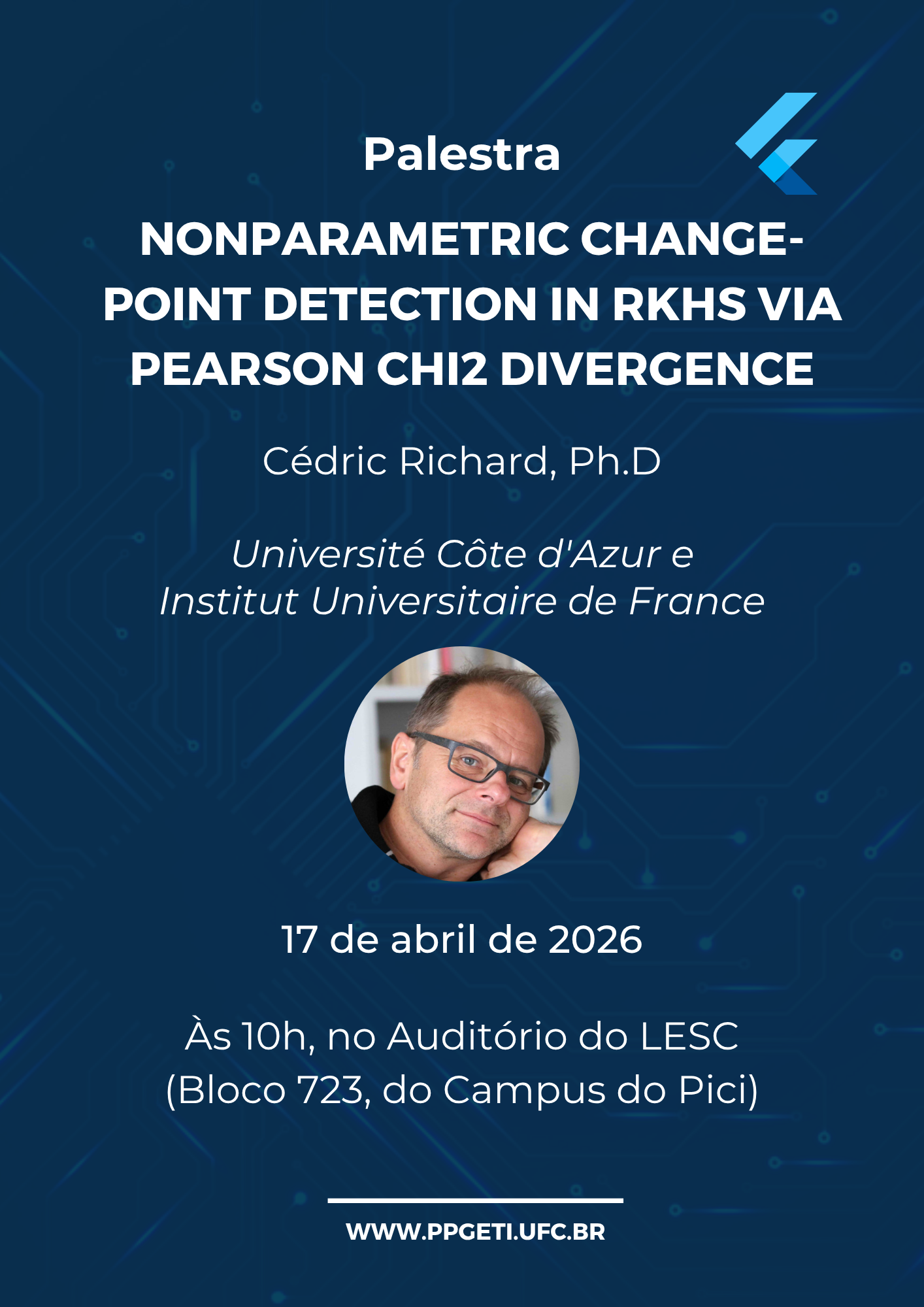
Palestra: Nonparametric change-point detection in RKHS via Pearson Chi2 divergence: Theory, guarantees, and ongoing extensions
Palestrante: Cédric Richard, Université Côte d’Azur and Institut Universitaire de France
Data: 17 de abril de 2026
Horário: 10h
Local: Auditório do LESC, bloco 723
Abstract: This presentation addresses nonparametric online change-point detection through a variational formulation of the Pearson Chi2 divergence in a reproducing kernel Hilbert space (RKHS). Starting from a density-ratio estimation viewpoint, it develops sequential detection rules together with explicit finite-sample guarantees under the no-change regime, including concentration bounds, average run length control, and uniform false-alarm probability control. A second part introduces a regularized kernel-based formulation, leading to sharper null tail bounds and to per-time missed-detection bounds. The talk concludes with ongoing extensions toward finite-dimensional dictionary representations, Gaussian pre-change models, and broader functional classes beyond RKHS.
Biography: Cédric Richard (S’98, M’01, SM’07) received the M.Sc. and Ph.D. degrees from the University of Technology of Compiègne, France, in 1994 and 1998, respectively. He is currently a Full Professor (Exceptional Class) in Electrical Engineering at Université Côte d’Azur, Nice, France. He has been a member of the Institut Universitaire de France (IUF), first as a Junior Member (2010–2015) and currently as a Senior Member (2025–2030). He has held a senior chair on AI for Smart Cities at the 3IA Côte d’Azur Institute, France, since 2020, and a senior chair at the SURE-AI Institute, Oslo, Norway, since 2026. With Prof. Petar Djuric, he co-edited the reference book Cooperative and Graph Signal Processing: Principles and Applications (Academic Press, 2018). Since 2024, he has served as Editor-in-Chief of Signal Processing (Elsevier). His recent leadership roles also include Chair of the IEEE Signal Processing Society Technical Committee on Signal Processing Theory and Methods (2023–2024) and Director-at-Large (Region 8) of the IEEE Signal Processing Society (2019–2020). He was also an elected member of the IEEE Machine Learning for Signal Processing Technical Committee (2012–2018). Prof. Richard served as Senior Area Chair for the IEEE Signal Processing Letters (2020–2022) and the IEEE Transactions on Signal Processing (2015–2018). Prof. Richard was General Co-Chair of EUSIPCO 2020, in Amsterdam, The Netherlands. He also served as Local Co-Chair of the IEEE CAMSAP 2019 Workshop. He was Special Session Chair of the IEEE SAM 2016 Workshop, held in Rio de Janeiro, Brazil. He was Technical Co-Chair of the IEEE CAMSAP 2015 Workshop, held in Cancún, Mexico, and of EUSIPCO 2015, held in Nice, France. He was General Chair of the IEEE SSP 2011 Workshop, held in Nice, France. In France, he also served as Director of the CNRS research federation ISIS (Information, Signal, Image, Vision) from 2019 to 2023. This major national research network is dedicated to fostering and promoting research in signal and image processing. It plays a key role in supporting ongoing research efforts in France and encouraging the emergence of promising new topics. ISIS brings together more than 4,600 members from 205 academic research laboratories and is supported by 20 major companies. From 2012 to 2019, Prof. Richard was also an elected member of the French National Council of Universities in Electrical Engineering. Prof. Richard is also a co-founder of SequoIA Analytics, a startup developing AI-based solutions for large-scale monitoring using fiber-optic sensing infrastructures, with applications notably in transportation and smart-city environments. Prof. Richard received the 2025 EURASIP Meritorious Service Award for his outstanding leadership and contributions as General Chair and Technical Chair of signal processing conferences, and as Editor-in-Chief of Signal Processing. More details in https://www.cedric-richard.